
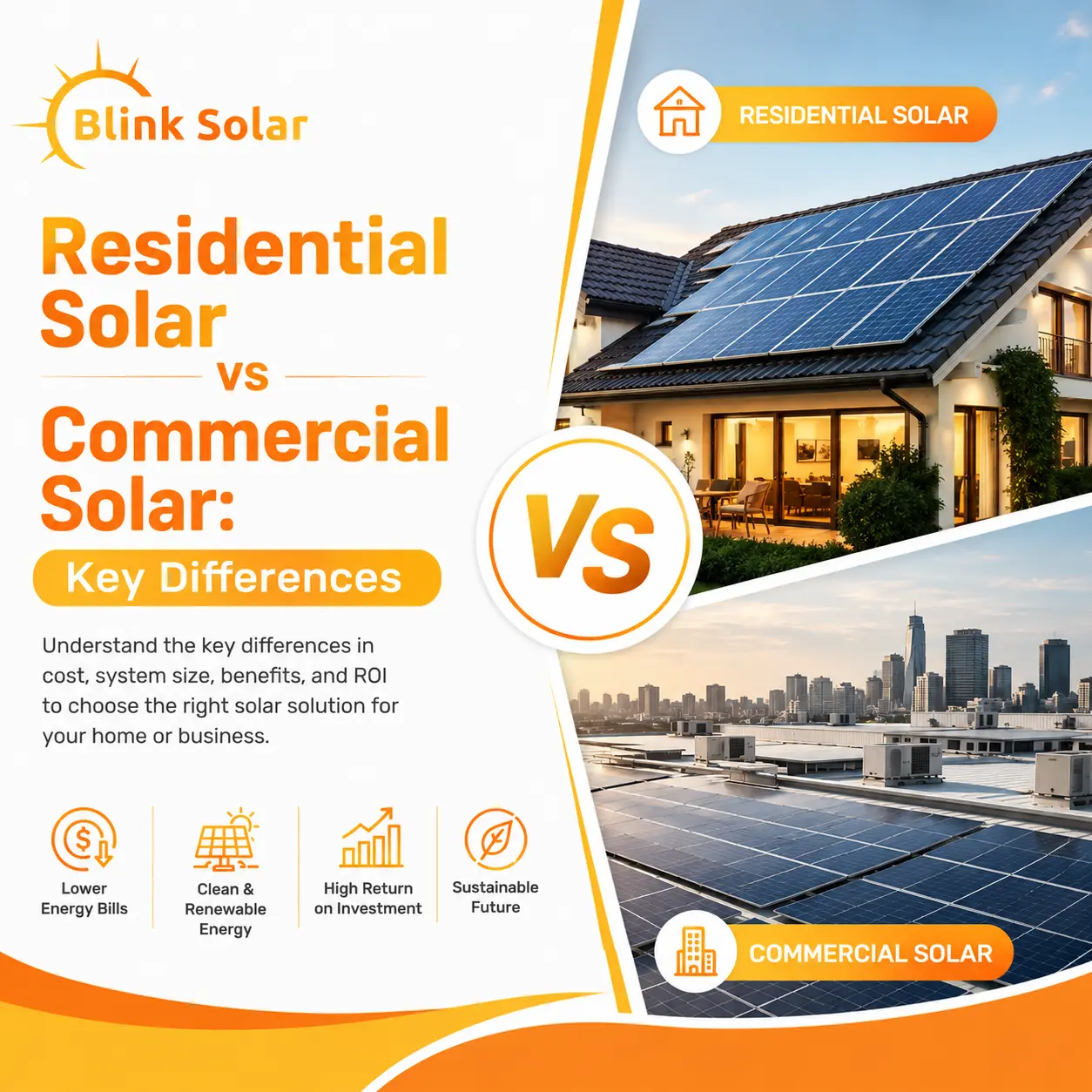
Solar energy is now among the most efficient means of lowering the costs on electricity and contributing to a more environmentally-friendly future. The uptake of solar is still increasing at a rate in Australia with homeowners and businesses seeking affordable and viable sources of energy. Although residential and commercial solar systems make use of the same basic technology to turn solar energy into electricity, these systems are very much different in their design, magnitude, cost and use. To build the appropriate investment decision based on the energy needs and long-term purposes, it is crucial to learn the distinction between a residential solar and commercial solar.
Residential solar systems have been specially designed to serve homes and residential buildings. They are normally mounted on the roofs and come in the size dependent on the amount of electricity a family uses. The residential solar systems normally vary between 3kW and 15kW, depending on the size of the house and the occupants. Residential solar enables homeowners to produce power on their own, minimize reliance on the grid and minimize monthly power bills. There has been a steep increase in residential solar uptake in Australia with most households moving towards sustainable solutions of clean energy in order to save in the long run.
Commercial solar, in its turn, is targeted toward companies, factories, warehouses, and schools, shopping centres, and other commercial establishments. These are much bigger systems since commercial properties usually use a lot of electricity as compared to the homes. Depending on the size of the business and amount of energy required, commercial solar installations may be as small as 20kW or as large as several megawatts. The main aim of commercial solar is to lower the cost of operations, enhance energy efficiency, and augment the profitability in the long term.
One of the most noticeable differences between residential solar and commercial solar is system size. Domestic solar systems are equipped to satisfy domestic energy needs, which tend to be less and more predictable. The commercial solar systems are tailored to provide very high loads of energy during the day. Companies tend to run machinery, equipment, lighting system, air conditioners and computers at the same time making the solar system to produce a lot more energy.
The way of its installation also differs significantly. Residential solar systems can be made within a few days since the systems are smaller and require fewer panels. Commercial solar initiatives take longer than residential to plan, engineer and get compliance. Commercial rooftops that are large in place might require structural inspection prior to installation. Ground-mounted solar arrays might be adopted by businesses in certain instances when there is adequate space.
Patterns of energy consumption differ as well. Residential buildings tend to have more electricity consumption in the mornings and evenings which happen when people are at their homes. This has led to the export of surplus solar energy to the grid by homeowners during the daytime. The commercial properties typically use the most amount of electricity during the day, which perfectly coincides with the optimum output of the solar power. This means that businesses will be able to utilize a higher fraction of the electricity generated by their solar systems, enhancing overall efficiency and ROI.
The two types of systems also vary widely in regard to the cost of installation. Residential solar is less expensive because of the size which is smaller. This can restore the investment of many homeowners by saving on energy within a few years. Commercial solar systems are plagued with increased capital investment since they demand more solar panels, inverters, mounting block and engineering efforts. The bigger scale usually though leads to higher savings in the long run and higher financial payoff.
Another aspect through which the residential solar and commercial solar are different is choice of equipment. Standard rooftop solar panels with residential-grade inverters are generally used in residential solar systems. Large commercial solar projects might employ newer inverter technology, monitoring software and energy control systems in order to optimize the performance of large plants. Businesses have a tendency of needing more advanced monitoring solutions to ensure that energy production, consumption and system performance is monitored in real time.
The design of the roof is also a significant factor. Residential solar is typically mounted on slant roofs with low area. Home owners will have to reach maximum production of energy in the roof area available. Since commercial buildings are often provided with large flat roofs, there is more freedom of positioning and orientation of the panels. This enables commercial solar systems to handle a significantly high volume of panels and attain a high degree of energy generation.
Maintenance requirements can vary as well. No special attention to residential solar systems; Maintaining a solar system usually involves only a few actions, such as regular cleaning and maintenance. An example is that commercial solar installations need a more detailed maintenance program because they are bigger and more complex. Monitoring regularly will be used to ensure the performance is optimal and will reduce downtimes, which may impact business activities.
Residential solar and commercial solar have different financial benefits that are laid out in different ways. The most common example of residential solar is to assist homeowners in lowering their electricity costs and enhancing property value. Generating their own electricity, many households are able to save a lot of money and even sell the surplus of electricity back into the grid where it can be utilized. The commercial solar also generates wider financial benefits by cutting down the costs of operations, enhancing the cash flow and cushioning businesses against future rise in the electricity prices. Those companies that use a lot of energy, such as the energy intensive industries, these savings can be really high in the lifetime of the system.
Another consideration is the environmental impact. Residential as well as commercial solar help to cut greenhouse gases and reliance on fossil fuels. Nonetheless, large volumes of clean energy are usually produced through commercial solar projects because of their magnitudes. Commercial rooftops that are large are a big prospect of increasing renewable energy production and sustaining a cleaner energy future.
The integration of battery storage is becoming generally widespread in both industries. The batteries can be installed in residential houses and enable the generation of extra power throughout the day and used at night. Battery systems offered by companies come with other advantages, like demand control, reserve power, and energy resiliency. With the current improving battery technology, residential solar and commercial solar systems are projected to be more efficient and economical.
Another significant difference is scalability. Solar systems installed in residential buildings have a generally confined size by roof and other household power demands. Business expansion can also easily expand commercial solar systems. To address the growing energy needs, a company can start with a smaller-sized installation and expand the panels in case of inadequacy in the rise.
Residential solar users and commercial solar users are still enjoying the benefit of technology advancement. The solar panels manufactured now are more efficient, durable and have better performance than the previous generations. Smart monitoring devices, sophisticated inverters and battery storage solutions are enabling the maximum production of energy and enhance the reliability of systems. Australia is still leading in the adoption of solar power which shows that renewable energy is increasingly important to households and businesses.
